
 Home
Home Products
 Resources
 Solutions
 Pricing
 Company
 Find Us
Agent Management Platform for Enterprise AI
How to manage AI agents, reduce shadow AI, and centralize observability, security, and costs

Summary
As enterprise AI applications multiply, the real challenge of AI in enterprise is no longer model access. It is governance.
Teams quickly end up running multiple AI agents across ADP, Dify, in-house tools, third-party execution platforms, and messaging channels. That creates shadow AI, agent sprawl, fragmented access, weak controls, unclear ownership, and rising operating complexity.
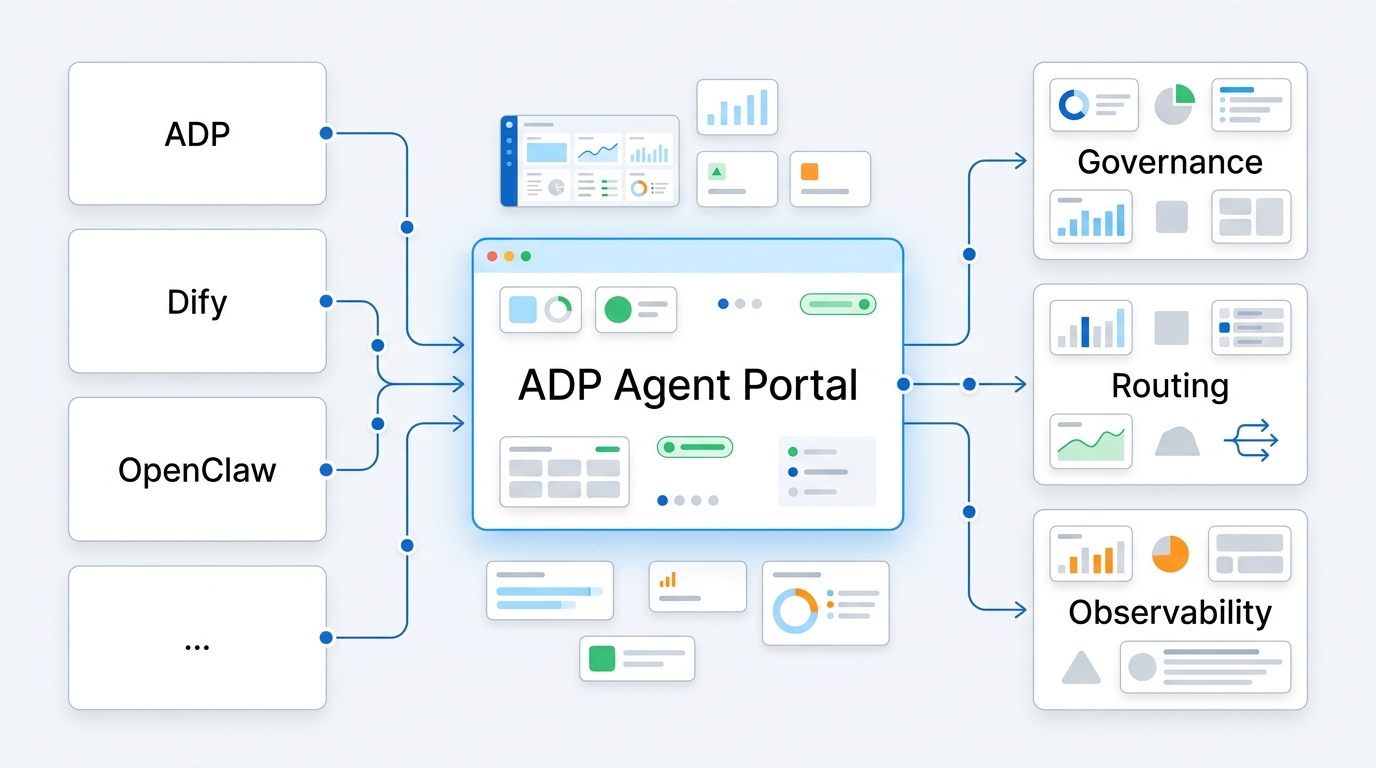
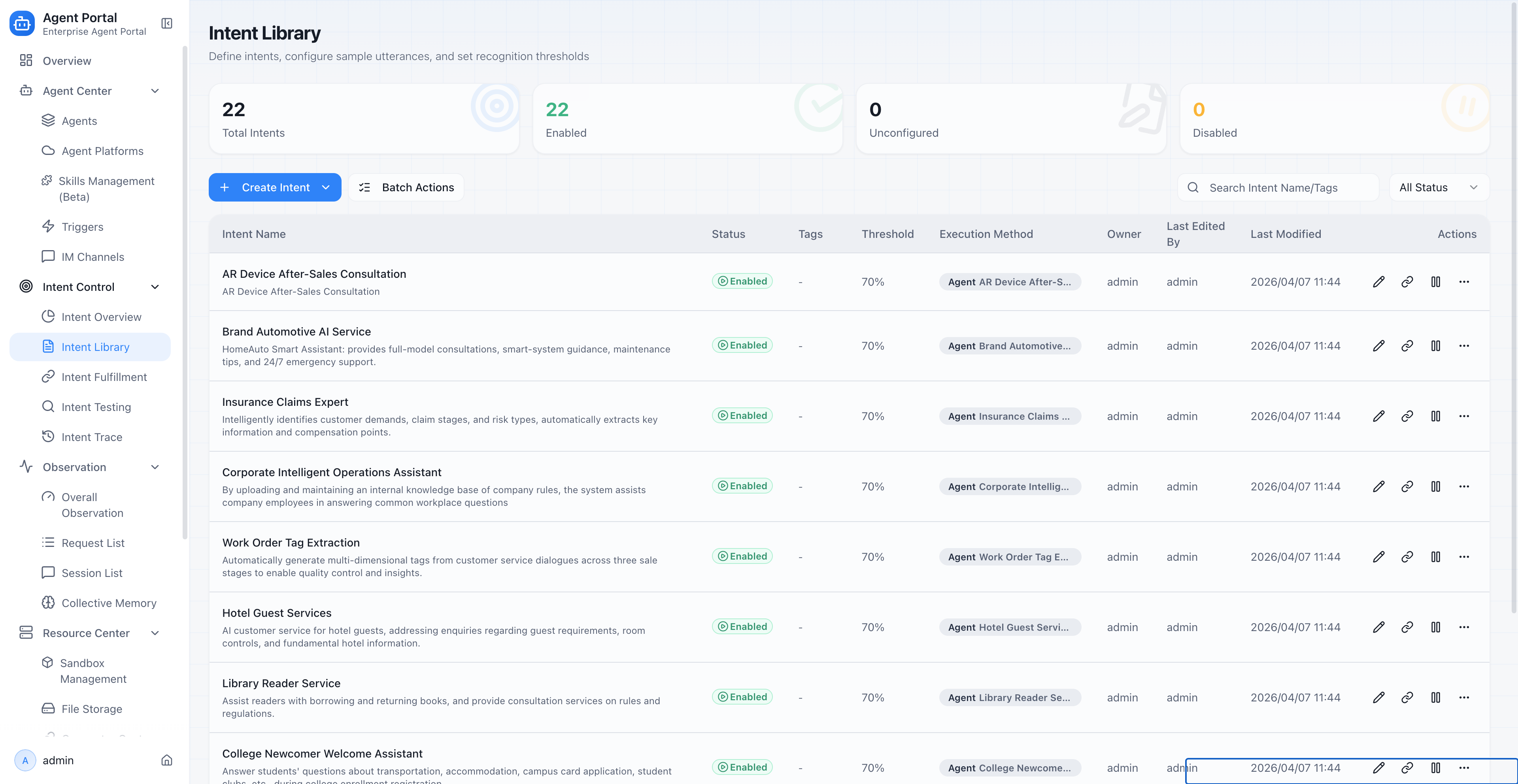
ADP Agent Portal is designed for that second-stage problem. It works as an enterprise AI platform, an agent management platform, and an AI agent orchestration platform for organizations that need centralized AI access, routing, governance, and operational visibility.
Put simply: if the first phase of enterprise AI was building agents, the next phase is learning how to manage AI agents as a system.
Key takeaways:
- ADP Agent Portal acts as both an enterprise AI platform and an agent management platform
- It reduces shadow AI and agent sprawl with a centralized AI entry point and governance layer
- It supports multiple AI agents, routing, and multi agent collaboration across systems
- It provides an AI agent dashboard with AI agent monitoring and AI agent observability
- It helps enterprises improve AI agent security and control AI agent costs
1. Shadow AI and Agent Sprawl Are the New Enterprise Problem
As AI in enterprise moves from pilots to production, many organizations enter a second stage of implementation.
In the first stage, the main questions are:
- Can we build an agent?
- Can we connect a model?
- Can we get one business scenario working?
In the second stage, the questions change:
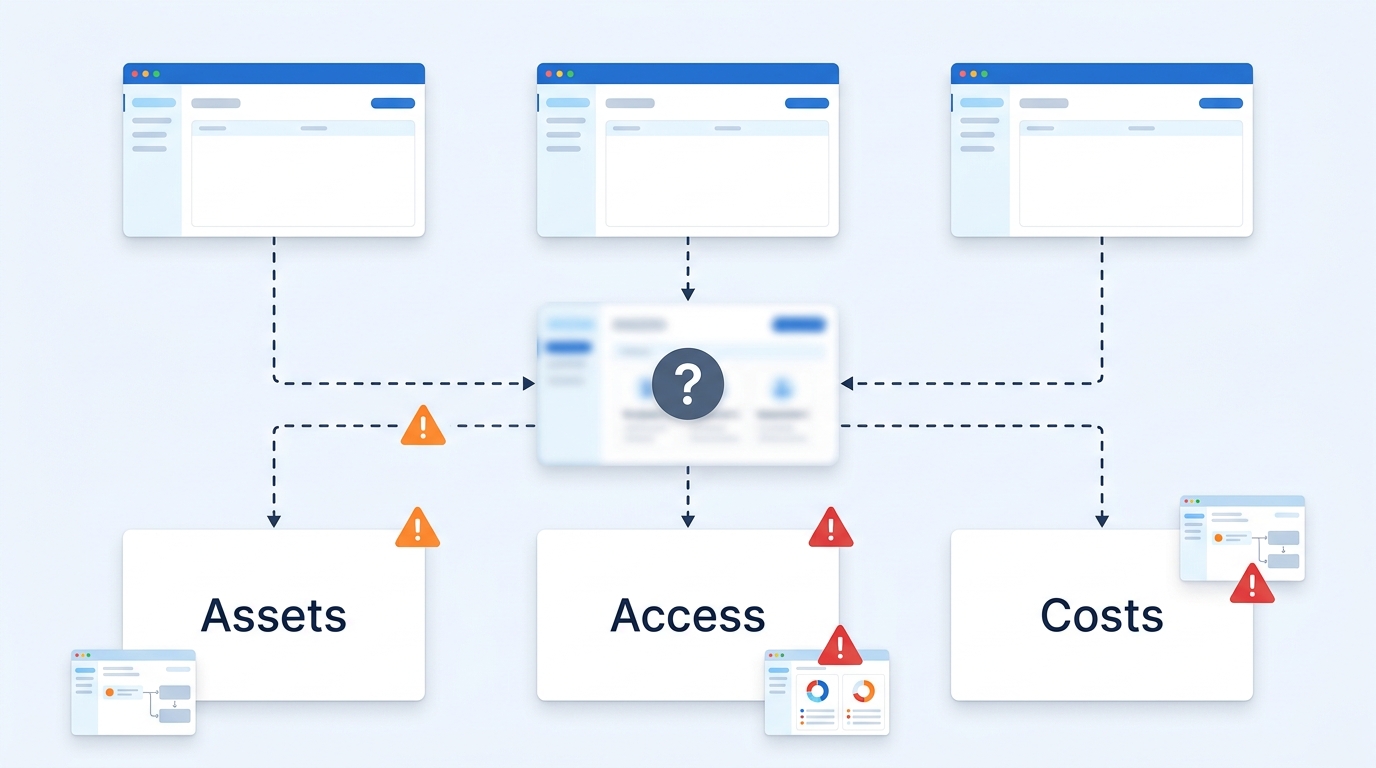
- The company has more and more agents, but nobody knows whether they can collaborate on complex work
- Different teams use different platforms, so assets become fragmented and hard to manage centrally
- Users do not know which agent to ask, or even what agents the company already has
- Similar requests are repeatedly sent to different models and flows, pushing cost upward
- When something breaks, teams cannot quickly tell which platform, agent, or step failed
At that point, enterprises no longer need just "an agent that can answer questions." They need a platform that can organize, dispatch, and govern enterprise agent assets at scale. This is exactly how shadow AI and agent sprawl start showing up in real operations.
That is exactly the problem ADP Agent Portal is designed to solve.
2. What is ADP Agent Portal?
In one sentence: ADP Agent Portal is an enterprise AI platform and agent management platform for companies that need to manage AI agents across systems, channels, and teams.
Its value can be understood in three layers:
| Layer | Problem it solves | Core value |
|---|---|---|
| Portal Layer | AI capabilities are scattered across internal and external entry points | Gives users a unified place to discover and access agents |
| Collaboration Layer | Multiple platforms and agents lack clear division of labor | Functions as an AI agent orchestration platform for routing, triggers, channel access, and orchestration |
| Governance Layer | Agent quality, cost, and stability are hard to see | Provides observability and operating analytics for continuous optimization |
So ADP Agent Portal is not just an "agent list page," and it is not simply an admin console either. It is better understood as a centralized AI control plane than as just another standalone agent platform.
More accurately, it is the infrastructure for managing digital employees:
- It brings all enterprise digital employees into one system
- It clarifies what each one is good at
- It determines which work should go to which agent
- It shows how each agent is performing, what it costs, and whether it should keep running
If enterprise AI becomes a growing digital workforce, ADP Agent Portal is the organizational hub for that workforce.
3. Why do enterprises need a centralized AI layer for multiple AI agents?
Because enterprise agents rarely come from one platform only.
In practice, a typical enterprise AI landscape often looks like this:
| Source | Typical form | Common issue |
|---|---|---|
| ADP agents | Production business agents, operations bots | Visible inside one platform, hard to govern outside it |
| Dify apps / workflows | Department-built flows and experiments | Too many versions, inconsistent naming, no shared view |
| In-house / direct LLM tools | Internal copilots and assistants | Fragmented APIs, difficult to standardize |
| Third-party execution platforms | Coding agents, automation agents | Detached from the rest of enterprise AI assets |
| OpenClaw governance solution | Team-level AI management and organizational AI operations | Without centralized access, permissions, monitoring, and operations, AI stays fragmented instead of becoming an enterprise asset |
| Channel bots | WeCom, Feishu, DingTalk, Slack, Telegram | Many touchpoints, but governance is split across systems |
Each capability may work on its own, but once these assets accumulate inside an enterprise, a few recurring problems appear.
3.1 Agent assets keep multiplying, but nobody has a unified view
Enterprises struggle to answer very basic questions:
- How many agents do we actually have?
- Which ones are still active and which are obsolete?
- Which ones serve customers and which ones serve employees?
- Which team owns each one?
Without unified management, there is no shared asset directory. Without a shared asset directory, real governance is impossible.
This is how agent sprawl shows up operationally.
3.2 User entry points are fragmented, so the experience becomes inconsistent
Some agents live on the web. Some are hidden in business systems. Some sit inside enterprise messaging tools. Some can only be accessed if the technical team tells you how.
That directly leads to:
- Users failing to find the right agent
- Teams rebuilding the same capability more than once
- Low adoption, because agents never become a natural part of daily work
This is also how shadow AI spreads inside organizations: useful tools exist, but nobody can govern them consistently.
3.3 Agents have no clear division of labor
Many enterprises do not lack agents. What they lack is coordination:
- A request that should go to a specialized business agent gets sent to a general assistant instead
- Similar problems consume compute across multiple platforms
- Complex scenarios fail to form a stable fulfillment path across multiple agents
The result is wasted cost and lower efficiency.
3.4 Without AI agent monitoring and AI agent observability, enterprises cannot make operating decisions
Without AI agent monitoring and AI agent observability, it is difficult to know:
- Which agents perform well
- Which agents fail too often
- Which requests take too long
- What the agent actually did during execution
- Which flows are most worth optimizing
The result is simple: the number of agents grows, but the enterprise still does not have a real capability for managing digital employees.
4. The core value of ADP Agent Portal is not "one more platform" but "organizing fragmented agents"
4.1 Unified management across platforms
The first layer of value in ADP Agent Portal is to bring scattered agents from different platforms into one enterprise management system.
For enterprises, that means:
- Managing agents as enterprise assets instead of platform-by-platform silos
- Making agents discoverable to business users, not just to technical teams
- Standardizing status, configuration, display, lifecycle, and permissions
In this model, ADP, Dify, direct LLM tools, in-house capabilities, and execution agents no longer operate as isolated islands. They become part of one enterprise agent estate. For many buyers, this is also where AI agent security starts becoming practical: permissions, auditability, lifecycle controls, and deployment policies stop being scattered across separate tools.
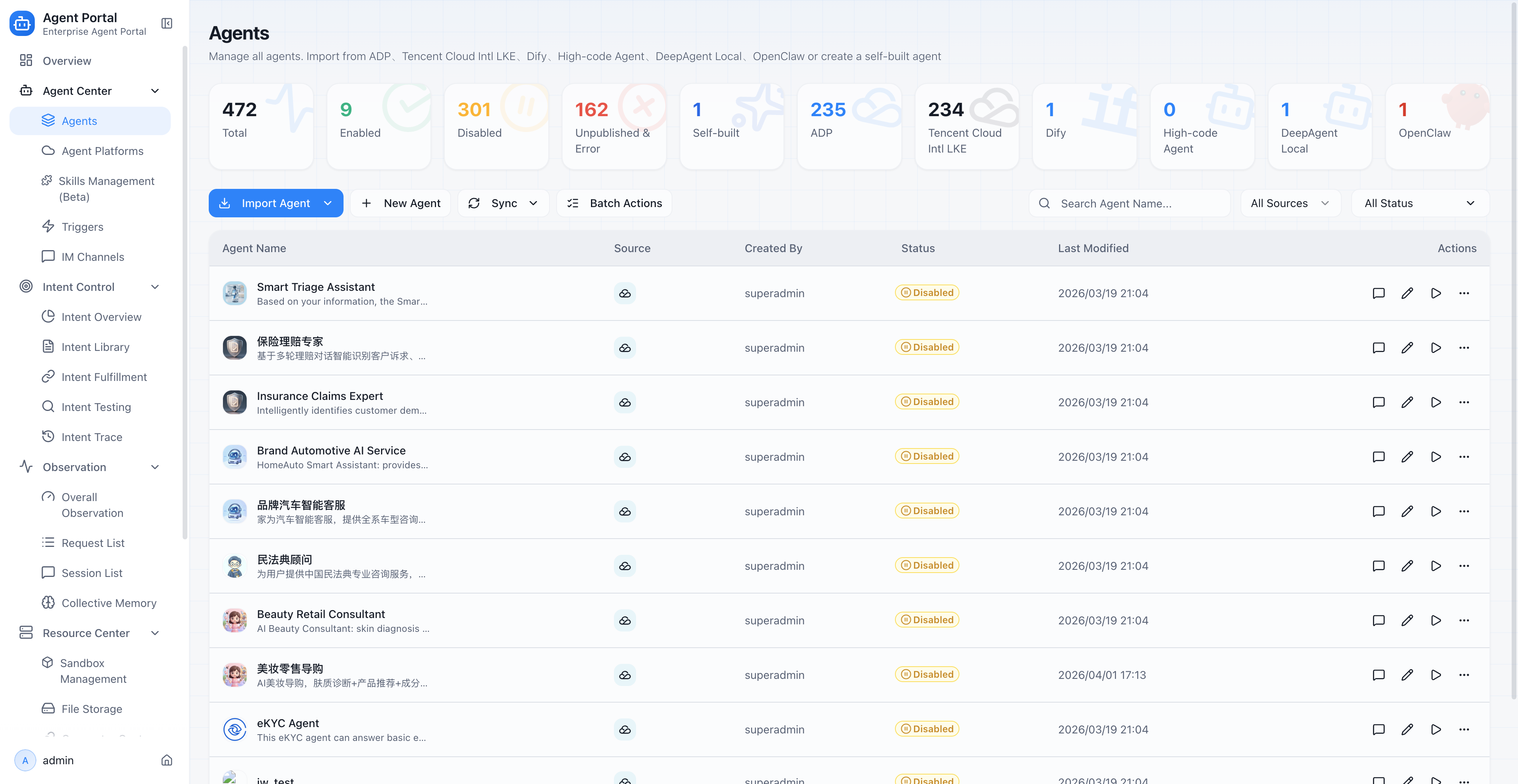
OpenClaw shows why enterprises need more than a standalone agent
OpenClaw is a useful example here. The challenge is not whether one agent is powerful enough. The challenge is whether AI remains a personal productivity tool or becomes an organizational asset.
Once AI use expands across teams, enterprises face the same recurring issues:
- Different employees adopt different tools, creating shadow AI
- Data moves across external endpoints, models, and business systems with blurry boundaries
- Usage, permissions, prompts, knowledge, and skills become fragmented
- Good practices stay with individuals instead of becoming reusable enterprise capabilities
That is why enterprises need more than another agent. They need centralized AI access, dispatch, monitoring, and governance.
Placed in the ADP Agent Portal context, the value becomes clearer:
- On the employee side, a unified portal, search experience, and simpler agent deployment reduce the friction of rolling AI out across the company
- On the orchestration side, requests can be dispatched to the best-fit agent or execution path instead of leaving multiple AI agents isolated
- On the management side, AI agent security, permissions, audits, and runtime visibility become easier to standardize
- On the asset side, prompts, knowledge bases, workflows, and skills can be accumulated as organizational capability rather than isolated personal know-how
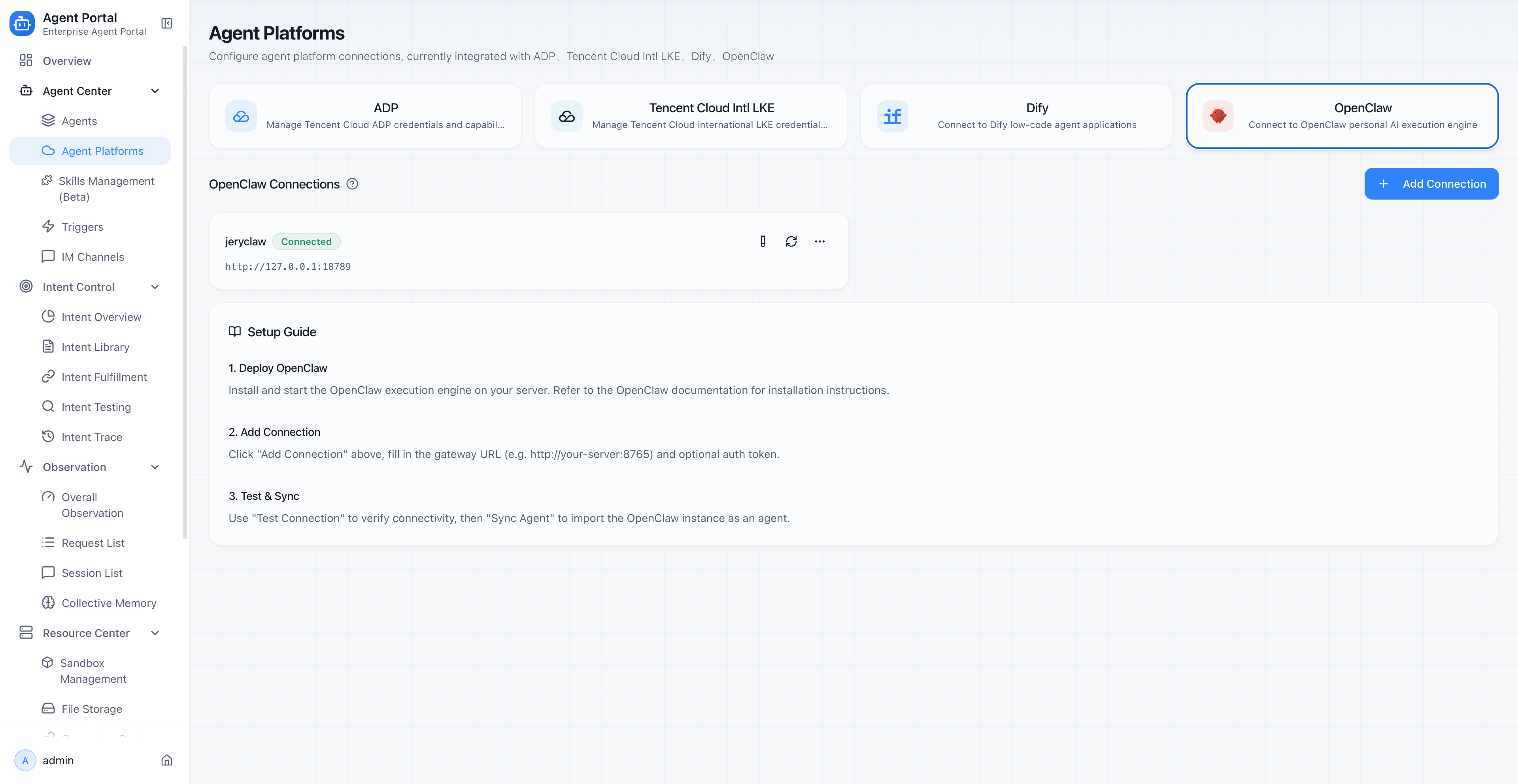
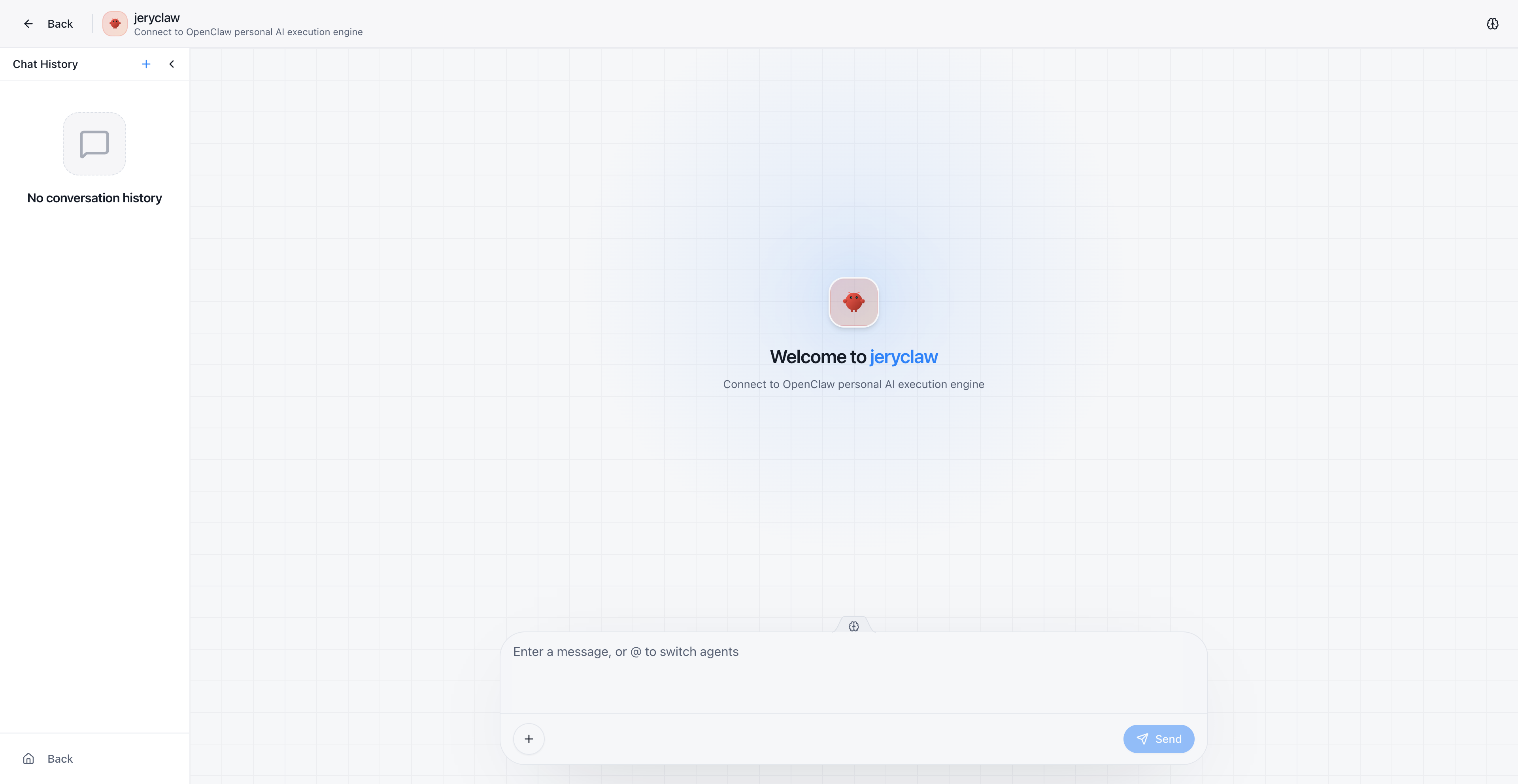
4.2 A unified portal turns agents into a true service entry point
The second layer of value is turning enterprise AI from scattered utilities into one accessible service surface.
It can serve both internal employees and external users:
- Internally, it acts as a unified workspace for digital employees
- Externally, it acts as a portal for enterprise AI services
This makes it easier to create a consistent experience:
- Start from one AI homepage
- Find agents by scenario
- Access different capabilities by role, org, or permission
- Use chat, models, canvases, collaboration tools, and solutions in one environment
For enterprises, this is the difference between "many AI tools" and "a usable enterprise AI portal."
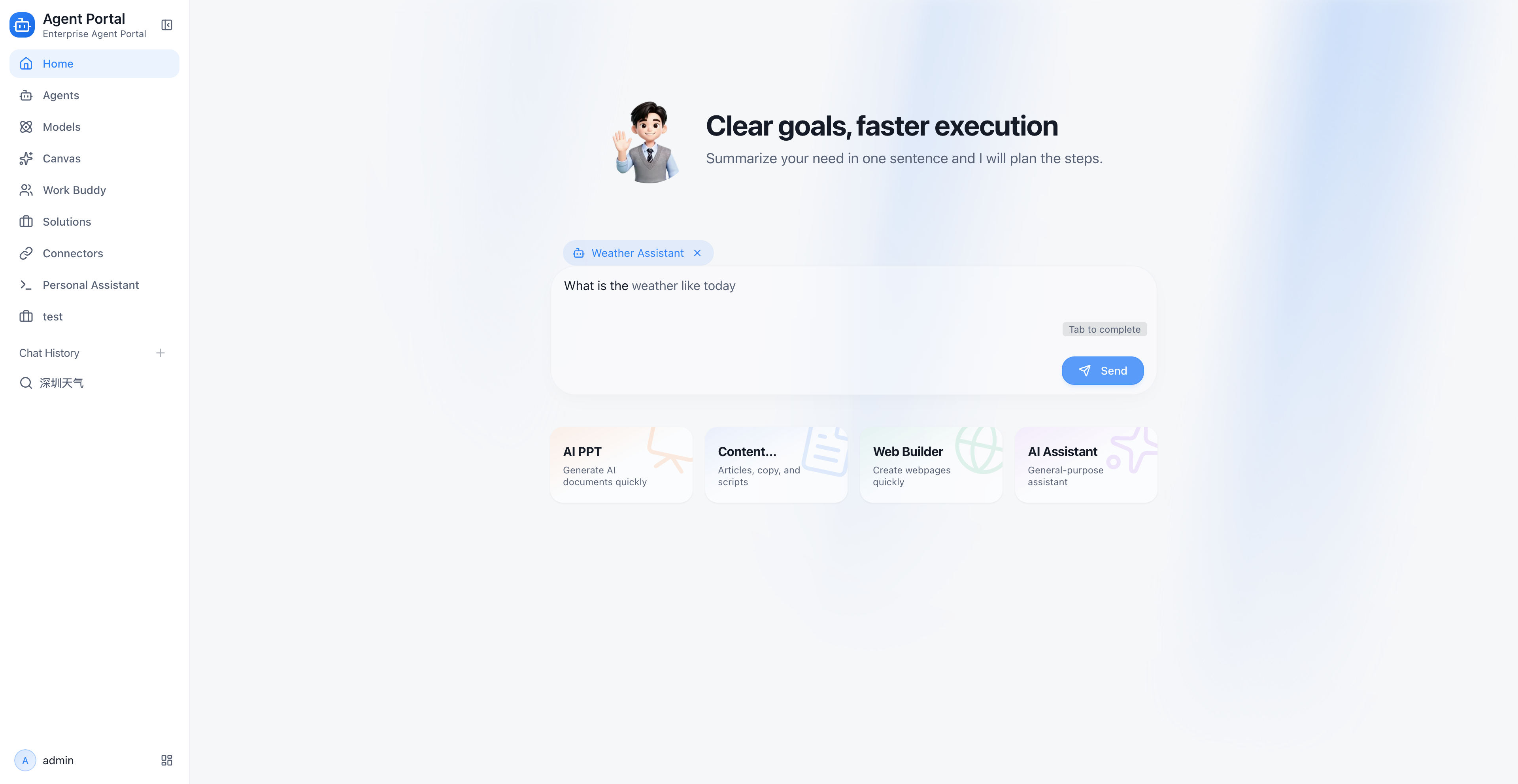
4.3 An AI agent orchestration platform gives digital employees a clearer division of labor
In enterprise AI, the expensive mistake is not "having one more agent." It is sending the wrong work to the wrong agent.
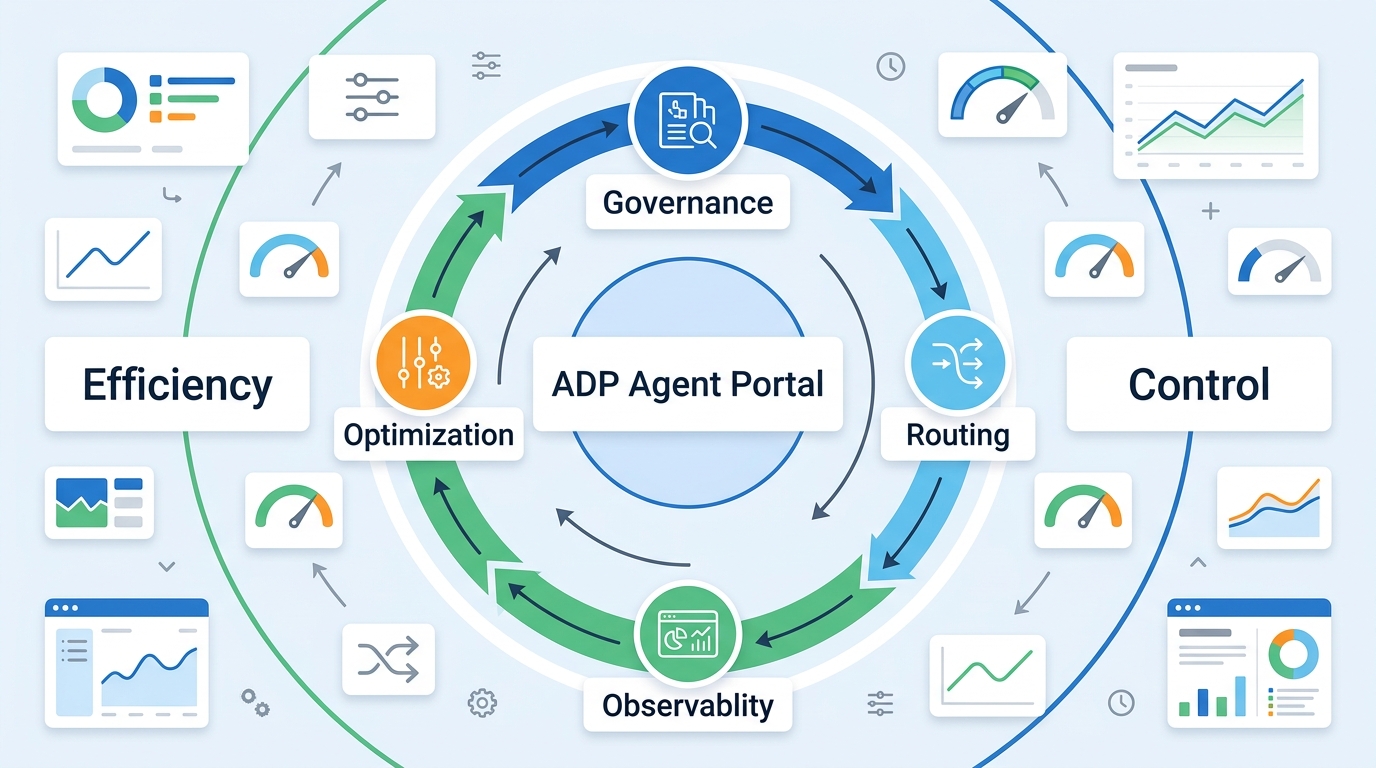
That is why intelligent routing matters. This is where ADP Agent Portal behaves like an AI agent orchestration platform. It solves a real resource-allocation problem:
- Which requests should go to which agent
- Which requests should be sent directly to one platform capability
- Which requests need intent recognition and fulfillment policies
- Which requests should enter automation, webhooks, or scheduled execution
Its value is not just "smarter." It is also "leaner":
- Fewer unnecessary model calls
- Lower failure rates caused by bad routing
- Faster response times
- Better utilization of agent resources
From an enterprise view, intelligent routing is basically shift scheduling and dispatching for digital employees. It also creates a more usable model for multi agent collaboration across platforms.
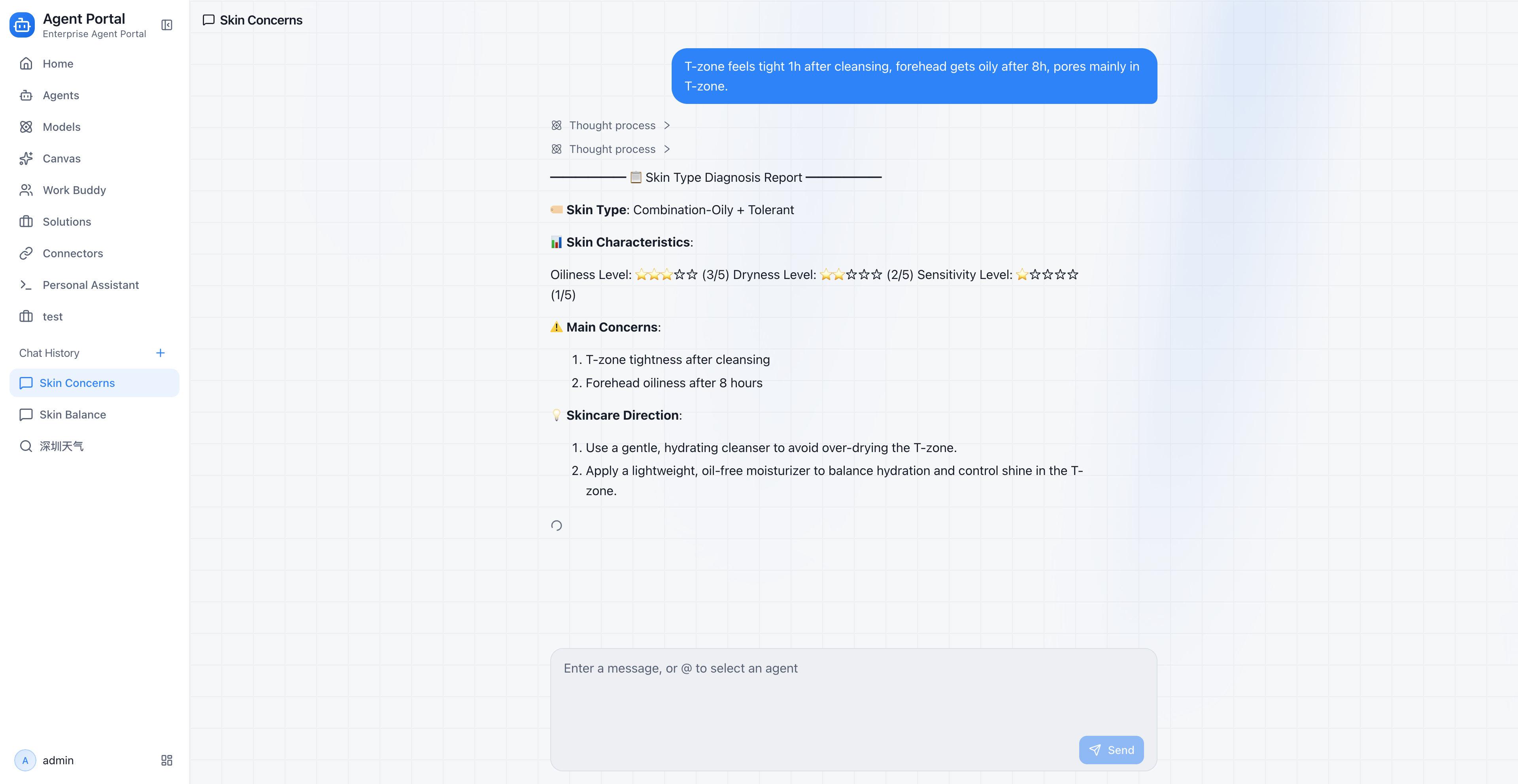
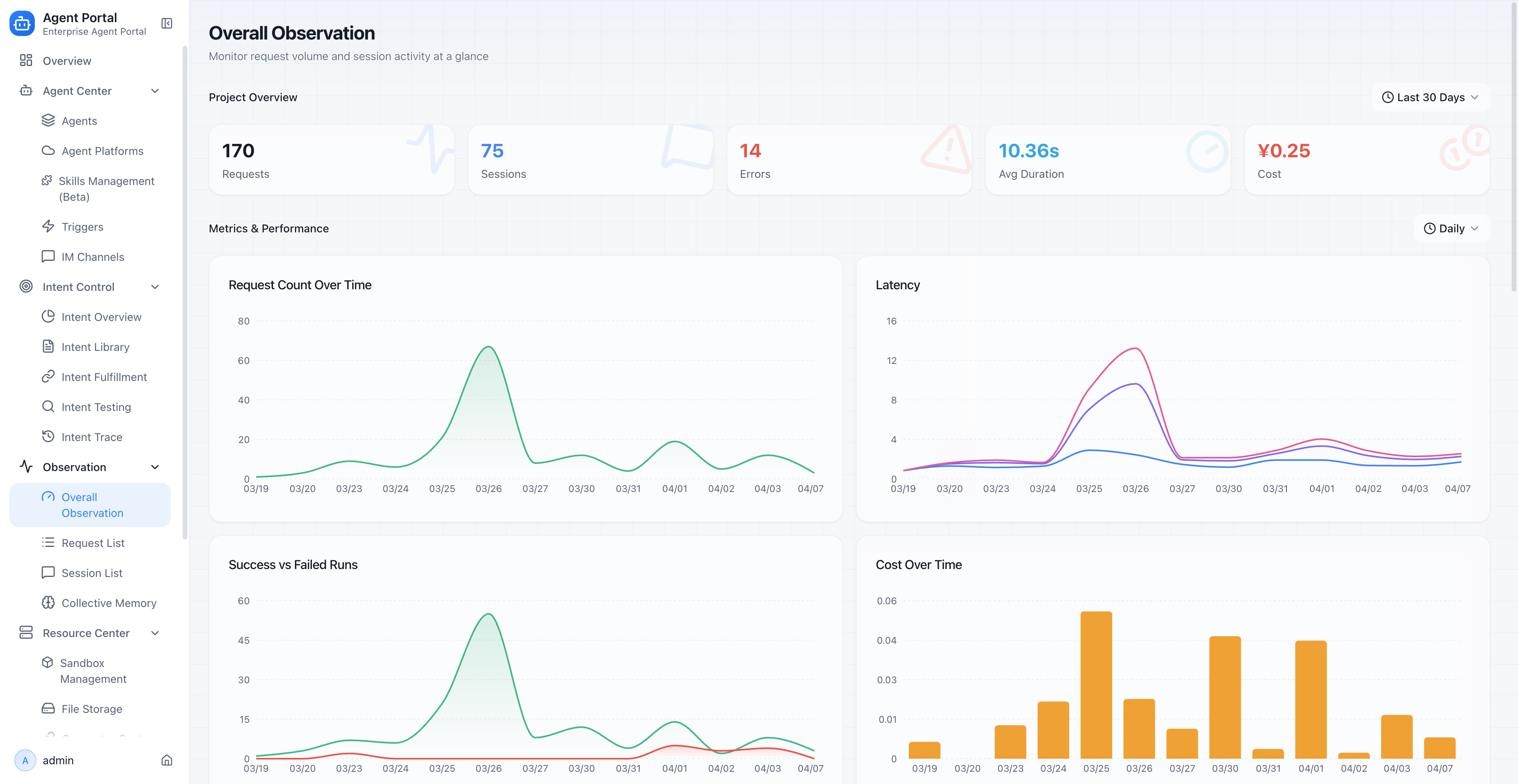
4.4 AI agent monitoring, AI agent observability, and the AI agent dashboard
Without AI agent monitoring and AI agent observability, enterprises cannot effectively manage digital employees.
Because management is never just about "making the system run." It is about being able to:
- See what is happening
- Explain what happened
- Trace the path back
- Improve the system over time
ADP Agent Portal acts as an AI agent dashboard for runtime statistics, traces, success rates, latency, error analysis, session history, and process tracking. For many enterprises, this is the first time agent performance can be evaluated the way team performance is evaluated.
That means enterprises can finally know:
- Which agents are most active
- Which paths take the longest
- Which scenarios fail most often
- Which models cost the most
- Whether optimization actually improved outcomes
Without these capabilities, agents are merely "running." With them, agents enter a real operating state and a more usable enterprise AI governance framework.
5. What does it mean to manage "digital employees" like a team?
This is one of the clearest ways to understand the value of ADP Agent Portal.
When enterprises manage real teams, they usually do the following:
- Build an org structure
- Define roles
- Assign work
- Review performance
- Coordinate collaboration
- Control cost
ADP Agent Portal maps those same management actions into the digital employee world:
| Managing a real team | Managing digital employees | ADP Agent Portal capability |
|---|---|---|
| Build an organization roster | Know which agents exist across the company | Unified asset management, classification, and state management |
| Define roles and responsibilities | Clarify what each agent owns | Agent configuration, model binding, display, and tagging |
| Assign work appropriately | Route requests to the best-fit agent | Intent recognition, intelligent routing, fulfillment policies |
| Build collaboration mechanisms | Coordinate multiple agents on complex tasks | Triggers, channel integration, orchestration, and collaboration |
| Review performance | See who is efficient, expensive, or unstable | Dashboards, traces, runtime analytics, feedback loops |
| Control team cost | Spend budget on high-value scenarios instead of waste | Model management, cost analysis, optimization decisions |
So the biggest value of ADP Agent Portal is not just technical integration. It is helping enterprises build a new management capability:
Upgrade agents from isolated tools into a coordinated, governable, and continuously optimizable digital workforce.
6. Why does it improve AI agent costs?
AI agent costs are not just model bills. They are the result of platform decisions, routing choices, duplicated work, and operational inefficiency. That is why cost efficiency here is a direct result of platform-level governance.
6.1 Unified management reduces duplicated work
When multiple teams build similar agents on different platforms, the enterprise pays multiple times:
- Duplicate development cost
- Duplicate testing and tuning cost
- Duplicate operating cost
- Duplicate model cost
Once everything is managed together, the enterprise can decide more rationally:
- Which capabilities should be reused
- Which should be merged
- Which should be retired
6.2 Intelligent routing reduces wasteful calls
Not every request deserves the most expensive model or the most complex execution chain.
With routing and fulfillment policies, enterprises can allocate resources more intelligently:
- Simple questions use lightweight paths, such as fixed answers or direct LLM calls
- Professional questions go to vertical agents
- Fixed processes go to automation triggers
- Multi-step work goes to coordinated execution
That directly affects cost, speed, and stability.
6.3 Observability enables optimization instead of blind investment
Many enterprises are willing to invest in AI, but they hesitate when they cannot see results clearly.
Unified observability changes optimization from guesswork into data-driven operations:
- Optimize low-success paths first
- Review high-cost models first
- Productize high-frequency scenarios first
- Scale back low-value capabilities earlier
That makes AI spending look more like operating discipline and less like experimentation.
7. Which enterprises are the best fit for ADP Agent Portal?
ADP Agent Portal is especially suitable for the following types of organizations:
7.1 Enterprises already running multiple agents across multiple platforms
If the company already uses ADP, Dify, in-house tools, or third-party AI platforms in parallel, the value of Portal is immediate because it solves unified management first.
7.2 Medium and large organizations that need one digital employee entry point
Once multiple departments start owning their own agents, the organization no longer needs "more apps." It needs one entry point, one rule system, and one governance model.
7.3 Enterprises with explicit requirements for cost, quality, and stability
Once AI enters production, "it runs" is not enough. Enterprises need to care about:
- Whether cost is reasonable
- Whether routing is accurate
- Whether operations are stable
- Whether problems are traceable
7.4 Teams that want AI to become a long-term capability, not a one-time project
If the goal is to build an operating model for digital employees rather than just launch a few pilot projects, Portal is much closer to the right direction.
8. How is this different from agent architecture in AI discussions?
The key difference is perspective.
Many conversations about agent architecture in AI focus on how to build one usable agent, one workflow, or one model stack. ADP Agent Portal focuses on what happens after the enterprise already has many agents and needs to organize, coordinate, and govern them.
You can think of the landscape like this:
| Type | Primary focus |
|---|---|
| Standalone agent product | Build one usable agent |
| Workflow / orchestration tool | Get one concrete process running |
| Model access layer | Connect to multiple models |
| ADP Agent Portal | Manage the enterprise digital workforce as a system and keep it running efficiently |
That is why it looks more like an enterprise agent hub than a single-point application.
FAQ
Q1: If an enterprise already uses multiple AI platforms, is Agent Portal still necessary?
Yes. In fact, the more platforms an enterprise already uses, the more valuable Portal becomes. The problem is no longer "Can we use them?" It is "How do we manage AI agents, coordinate them, and govern them together?"
Q2: Is it more of a usage portal or more of a management backend?
It is both. The real differentiation is that it combines entry, dispatch, and governance into one system. It is a portal, a collaboration console, and a governance console at the same time.
Q3: Why emphasize the idea of "digital employees"?
Because enterprise agent management increasingly resembles team management. The question is no longer whether one model can answer a question. It is whether the digital workforce has the right roles, task allocation, operating quality, and return on investment.
Q4: What is the business value of intelligent routing?
Its business value is simple: send the right task to the right agent and execution path, reduce wasteful calls, improve response efficiency, and control model and workflow cost more effectively.
Q5: How does this support an enterprise AI governance framework?
It supports an enterprise AI governance framework by centralizing access, permissions, observability, cost visibility, lifecycle control, and auditability. In practice, that means teams can move from informal AI usage to a governed operating model.
Q6: Does it help with AI agent security and agent deployment?
Yes. AI agent security improves when permissions, audit trails, and deployment policies are managed consistently instead of being scattered across tools. It also simplifies agent deployment by giving enterprises one portal, one release surface, and one governance model for rollout.
Closing Thoughts
Once enterprises move into the deeper phase of AI adoption, the hardest problem is rarely "Can we build an agent?" The harder problem is how to organize all the agents spread across different platforms, departments, and user entry points into a digital workforce that can collaborate, be governed, and improve over time.
That is the value of ADP Agent Portal.
Built on unified cross-platform management, intelligent routing, and observability, it helps enterprises turn scattered agent capabilities into an enterprise-grade digital workforce that can be operated continuously.
If the past phase of enterprise AI was about trying AI, ADP Agent Portal is about managing AI systematically.
Fill in the form to experience ADP Agent Portal We will contact you as soon as possible!
Related Reading
· How Enterprises Build AI Agents

Start building today
If you need more support, please contact us